

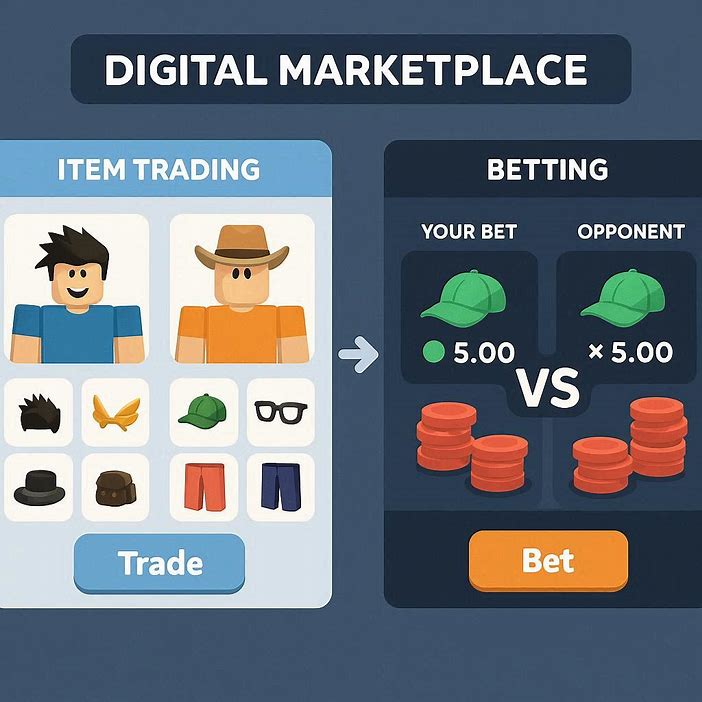
Roblox reports tens of millions of daily active users, with a significant portion of in-game interaction occurring through user-generated content and player-driven economies, according to Roblox Corporation’s developer reporting. Within this environment, virtual items such as skins, collectibles, and cosmetics can develop perceived value among users based on rarity, demand, and community trading activity.
In addition to official Roblox systems, third-party platforms have emerged that interact with Roblox item economies, often referred to as Roblox gambling sites. These services facilitate wagering-style mechanics using in-game items, particularly in relation to trading-heavy games such as Murder Mystery 2. These platforms operate outside Roblox’s official infrastructure and are not formally endorsed by the platform.
Development of User-Generated Trading Economies
The early Roblox economy primarily focused on simple item trading between players. Over time, limited availability of certain items and evolving community preferences contributed to informal valuation systems, where users assigned varying levels of worth to digital assets.
Industry reports on gaming economies suggest that user-generated content and trading systems in sandbox environments can influence player engagement. In Roblox, this has contributed to the development of informal marketplaces where item values fluctuate based on demand rather than fixed pricing structures.
As trading systems became more complex, external communities such as forums and messaging platforms were used to coordinate exchanges and evaluate item values. These developments created conditions in which structured wagering-like systems later appeared in some third-party services.
Emergence of Item-Based Betting-Style Platforms
Some third-party platforms associated with Roblox item economies introduced mechanics that resemble betting systems. These may include coinflip-style games, jackpot pools, or randomized item distribution systems.
In these models, users typically deposit virtual items or credits that are assigned standardized values within the platform. Outcomes are determined through automated systems, with winners receiving pooled items or rewards based on predefined probabilities.
While these systems are often described using gaming terminology, their structure shares similarities with chance-based reward mechanics. However, they operate using virtual goods rather than traditional currency and are external to Roblox’s official services.
Monetization Structures Used by Platforms
Platforms operating in this space commonly use several monetization methods. One is a transaction fee or “house edge,” where a percentage is retained from each wager or exchange.
Many platforms also implement internal valuation systems to assign standardized worth to items. This helps establish liquidity and enables consistent matching between users in different types of games or wagers.
Automated systems are often used to match participants of similar value ranges in order to facilitate balanced outcomes. These mechanisms are similar in structure to matchmaking systems used in other digital services, though applied in a different context.
In some cases, these monetization approaches are also discussed alongside broader industry patterns, including bonuses, referral incentives, and fast transaction cycles found in similar platforms. An overview of these mechanics can be found in discussions of business models of gambling-style apps, where similar structural elements are analyzed in a wider digital context.
Additional Features and Engagement Systems
Some platforms expand beyond basic wagering mechanics by incorporating referral programs, jackpot-style games, and social engagement features. Referral systems may reward users for bringing new participants into the platform through credits or bonuses.
Jackpot-style systems typically involve multiple users contributing items to a shared pool, with a single winner selected through an automated random process. These systems can result in high variability in outcomes due to the pooled nature of participation.
Coinflip-style mechanics remain one of the simplest formats used. In these cases, two participants place items of equal or similar value, and an automated system determines the winner through a randomized result.
Research in behavioral economics and gaming studies has examined how uncertainty and reward-based systems can influence user engagement, though interpretations of these effects vary across studies.
Role of User-Generated Economies
The existence and persistence of item-based wagering platforms are closely tied to the structure of user-generated economies. In Roblox, items created or distributed within the platform may acquire value based on scarcity, demand, and community perception.
Unlike centrally controlled economies, these systems can evolve dynamically based on user behavior. This variability may contribute to the formation of secondary markets where external platforms attempt to facilitate exchange or wagering systems.
Some economic research on digital platforms has noted increasing interest in virtual goods and digital ownership among younger users. However, the interpretation of these trends varies, and not all activity within these ecosystems is associated with monetary value or financial intent.
Regulatory and Ethical Considerations
Platforms that involve wagering-like mechanics using virtual goods may raise regulatory and ethical questions depending on jurisdiction and implementation. Concerns often relate to transparency, age accessibility, and the potential for gambling-like behavior involving digital items.
Because these platforms operate outside official game ecosystems, oversight and enforcement can vary. In some cases, platform policies or regional regulations may restrict or prohibit such activities, while in others the classification of virtual items remains legally ambiguous.
Conclusion
The development of Roblox-related item economies and associated third-party platforms reflects broader trends in digital asset interaction and user-generated markets. While some platforms incorporate betting-style mechanics, they operate in a complex environment shaped by informal valuation systems, technical design choices, and varying regulatory interpretations.
As virtual economies continue to evolve, distinctions between gameplay systems, digital marketplaces, and chance-based mechanics remain areas of ongoing discussion among developers, researchers, and regulators.